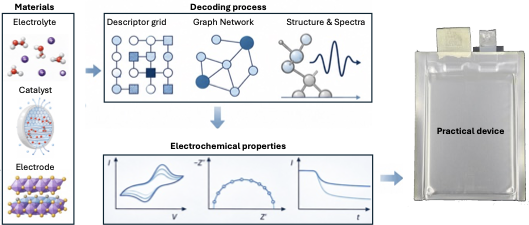
We use AI to prioritise electrolyte formulations for experimental screening against conductivity, stability and safety targets. We combine electrochemical measurements with operating history to diagnose degradation and predict remaining battery life. Techno-economic analysis (TEA) and life-cycle assessment (LCA) help us examine how materials, operating conditions and service life affect system costs and environmental impacts.
AI-guided electrolyte discovery · Battery health diagnostics · Lifetime prediction · Sustainability assessment (TEA and LCA)
AI-Guided Electrolyte Discovery
We use machine learning to prioritise electrolyte formulations for experimental screening. Our fragment- and composition-aware model screens candidates by ionic conductivity. Stability and safety are separate criteria for follow-up evaluation.
Related publications
Direct electrolyte screening study
- X. Wang, M. Chen, G. Bao, Y. Lai, J. Cao, X. Liu, R. Tan, “High‐Conductivity Electrolytes Screened Using Fragment‐ and Composition‐Aware Deep Learning,” Advanced Science, 2026, 13(14), e21575. DOI
Related data-driven materials design
- Y. Zhang, X. Shi, S. Yang, X. Liu, J. Ma, J. D. Akoto, R. Tan, M. An, H. Shang, S. Zhao, “Lithium-rich manganese- based cathode materials: Challenges facing next-generation lithium-ion batteries, electrolyte additive strategies, and artificial intelligence-assisted design,” Chinese Chemical Letters, 2026, 113136.
- X. Liu, K. Yang, L. Zhang, W. Wang, …, S. Yang, R. Tan, “A fast forward prediction framework for energy materials design based on machine learning methods,” Energy Material Advances, 2024, 5, 0131.
Battery Health Diagnostics and Lifetime Prediction
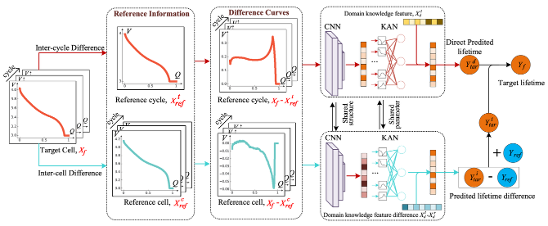
We use electrochemical measurements and operating history to estimate battery health. Our published work spans online state-of-health estimation, feature selection and transfer learning for early-stage and second-life assessment. We investigate how those signals can inform lifetime prediction.
Related publications
State estimation and early-stage assessment
- S. Guan, M. Shen, Z. He, Z. Dong, H. Wang, R. Tan, “Early-Cycle Lifetime Prediction of Li-Ion Batteries Across Diverse Degradation Conditions,” IEEE Transactions on Transportation Electrification, 2026, Early Access. DOI
- A. Xu, Y. Wang, G. Zhang, Y. Yang, R. Tan, W. Zhang, K. Yang, “Bringing real-time observability to practical aqueous zinc-ion batteries,” Energy Z, 2026, 2, 200015. DOI
- Z. Gao, H. Xie, … J. D. Akoto, R. Tan, S. Chen, “A data-driven methodology for early-stage estimation and second- life applicability assessment toward lifecycle refined management of power batteries,” Energy, 2025, 138281.
- X. Liu, K. Yang, B. Zou, … B. Ma, L. Zhang, R. Tan, “Accurate estimation of state of health for lithium-ion batteries based on Pyraformer and TimeGAN data augmentation,” Journal of Power Sources, 2025, 640, 236722.
- G. Bao, X. Liu, B. Zou, K. Yang, J. Zhao, … W. Wang, R. Tan, X. Wang, “Collaborative framework of Transformer and LSTM for enhanced state-of-charge estimation in lithium-ion batteries,” Energy, 2025, 322, 135548.
- W. Wang, K. Yang, L. Zhang, S. Zhou, B. Ren, Y. Lu, R. Tan, T. Zhu, B. Ma, S. Yang, X. Liu, “An end-cloud collaboration approach for online state-of-health estimation of lithium-ion batteries based on multi-feature and transformer,” Journal of Power Sources, 2024, 608, 234669. DOI
- B. Zou, M. Xiong, H. Wang, … W. Wang & R. Tan, “A Deep Learning Approach for State-of-Health Estimation of Lithium-Ion Batteries Based on a Multi-Feature and Attention Mechanism Collaboration,” Batteries, 2023, 9(6), 329.
Degradation and fault diagnosis
- F. Chen, F. Yang, H. Chu, J. Xu, K. Yang, … Z. Feng, R. Tan, “Electrochemical Modeling and Degradation Analysis of Lithium‐Ion Batteries in High Temperature Environments,” Battery Energy, 2026, 5(1), e70050.
- W. Ren, R. Tan, C. Qi, Y. Yang, X. Wang, S. Zhao, T. Zheng, “Study of Polarization-Induced Strain Distribution and Mechanical Damage in Lithium-Ion Batteries,” ACS Applied Materials & Interfaces, 2025, 17(50), 68579-68591.
- B. Zou, L. Zhang, X. Xue, R. Tan, P. Jiang, B. Ma, Z. Song, W. Hua, “A review on the fault and defect diagnosis of lithium-ion battery for electric vehicles,” Energies, 2023, 16(14), 5507.
Techno-Economic and Life-Cycle Assessment
We use techno-economic analysis and life-cycle assessment to examine how materials, operating conditions and service life affect costs and environmental impacts. Published flow-battery cost analysis, current-collector recycling studies and second-life screening inform distinct parts of this work.
Related publications
Cost analysis in a flow-battery case study
- Y. Xia, M. Ouyang, V. Yufit, R. Tan, A. Regoutz, A. Wang, W. Mao, B. Chakrabarti, A. Kavei, Q. Song, A. R. Kucernak, N. P. Brandon, “A cost-effective alkaline polysulfide-air redox flow battery enabled by a dual-membrane cell architecture,” Nature Communications, 2022, 13(1), 2388. DOI
Related environmental, recycling and second-life studies
- B. Robinson, J. Yang, R. Tan, S. Alekseev, C. T. J. Low, “Rethinking the Roles of Graphite and Graphene in Lithium‐ Ion Batteries From Environmental and Industrial Perspectives,” Carbon Energy, 2026, 8(1), e70099.
- Z. Gao, H. Xie, … J. D. Akoto, R. Tan, S. Chen, “A data-driven methodology for early-stage estimation and second- life applicability assessment toward lifecycle refined management of power batteries,” Energy, 2025, 138281.
- J. Yang, B. Robinson, H. Hao, J. Zhu, D. Tian, Z. Ye, B. Dong, K. Yang, S. R. P. Silva, Y. Zhao, X. Liu, R. Tan, C. T. J. Low, “Closing the Loop From Waste to Resource: A Comprehensive Review on Recycling Current Collectors in Lithium‐Ion Batteries,” cMat, 2025, 2(4), e70026.